
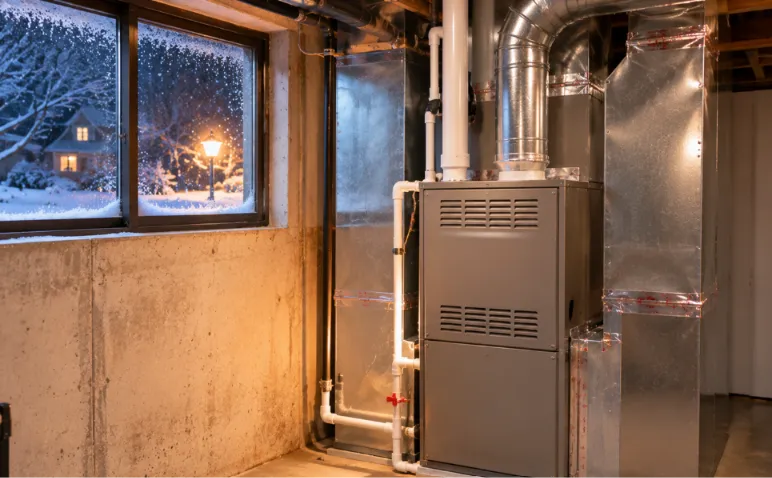
It can be. On a very cold Mentor night, a healthy furnace may run for long stretches and still be operating normally. Run time tracks the weather, and a cold snap off Lake Erie asks any furnace to replace heat faster than usual.
What matters is not how long it runs but what it achieves. If the house holds the thermostat setting, long cycles are normal. If the furnace runs nonstop and the house keeps slipping, or it starts and stops every few minutes, something needs attention before the coldest weeks arrive.
Why Does a Furnace Run Longer When It Is Colder Outside?
A furnace replaces the heat a house loses through walls, windows, the roof and air leaks. That loss grows with the gap between indoor and outdoor temperatures. All else being equal, the temperature difference is more than three times greater at 10°F than at 50°F, so the home loses heat much faster.
A furnace is sized to keep up on a cold design day, not to finish quickly. On the coldest nights, a correctly sized unit may run for long stretches, sometimes almost continuously. Repeated very short cycles on a frigid night can point to oversizing, airflow restrictions, thermostat issues, or another control problem.
Mentor sees plenty of cold winter nights. NOAA's 1991 to 2020 climate normals for nearby Cleveland put the average January low at about 22°F, with roughly 26 January nights at or below freezing. On colder nights, longer furnace cycles can be normal if the home is maintaining the thermostat setting.
Does the Type of Furnace Change What Normal Looks Like?
Yes. A single-stage furnace has one heating output: full heat or off. On cold nights it can run long cycles at full output, then shut off when the thermostat is satisfied. A single-stage furnace that runs continuously while the home loses temperature, or continues doing so after outdoor temperatures moderate, deserves a closer look.
Two-stage furnaces can operate at a lower heat output when the home needs less heat, which often leads to longer, steadier cycles. Modulating furnaces can adjust heating output in smaller increments as the load changes. A variable-speed blower adjusts airflow and is often paired with two-stage or modulating heating. Longer operation can therefore be completely normal on this equipment when the system is maintaining the thermostat setting.
Check the label or the manual if you are not sure which type you have, or ask during your next tune-up. Knowing the type answers half the question before anyone opens a panel, because a modulating furnace that runs all day may be perfectly healthy.
When Does Constant Running Point to a Problem?
Long running becomes a concern when it comes with other signs. These five patterns separate a furnace working hard from one that needs service, and you can spot most of them from the thermostat or a supply vent without opening anything on the furnace itself.
The House Never Reaches the Setpoint
If the furnace runs for hours and the house stays two or three degrees below the thermostat setting, it is losing ground. That can mean low output, an airflow restriction or a house losing heat faster than the furnace replaces it. On a mild day, it is a fault.
The Air From the Vents Feels Lukewarm
Furnace air should feel warm at the supply registers during an active heating cycle. If the house is falling behind and the supply air seems unusually cool, the system should be checked. A technician can measure temperature rise and combustion performance rather than relying on how the air feels.
It Starts and Stops Every Few Minutes
Rapid on-off cycling, called short cycling, is a different problem from long running. Possible causes include a clogged filter or blocked airflow triggering a safety limit, thermostat or control problems, flame-sensing issues, or an oversized furnace. Short cycling can reduce efficiency and increase wear on components.
The Fan Never Stops
If the thermostat fan is set to ON instead of AUTO, the blower runs all the time, even between heating cycles. Many homeowners mistake that for a furnace that never shuts off. Switch the fan to AUTO and watch whether the burners cycle off between calls for heat.
Gas Bills Jump Without a Cold Snap
Longer runs in colder weather raise bills, and that is expected. A sharp jump during a stretch of ordinary weather is different. It can point to a restricted filter, leaky ducts, a thermostat problem or a furnace losing efficiency, all worth checking before the coldest weeks arrive.
The takeaway is that run time alone tells you little. A furnace that runs long, keeps the house at the setpoint and blows warm air is coping with winter. One that runs long and still falls behind, short cycles or blows lukewarm air needs a technician.
Should You Buy a Bigger Furnace If Yours Runs All the Time?
When a furnace runs nonstop through January, it is tempting to assume it is too small and ask for a bigger replacement. A larger number on the label sounds like a furnace that would finish faster, shut off sooner and leave the house warmer on the coldest nights.
Here is the trap. Long runtime by itself does not prove the furnace is undersized. If the system maintains the thermostat setting during the conditions it was designed for, adding capacity may not solve anything. An oversized replacement can lead to shorter cycles, temperature swings, and comfort problems while drafts and leaky ducts stay unfixed.
Find out why it runs first. A technician can measure temperature rise, airflow and gas pressure, and check the filter, ducts and thermostat. Sealing and insulation often do more than new equipment, and any furnace replacement should be sized to the house.
What Do Common Long-Running Patterns Mean?
Most worries about a furnace that runs all the time fall into a few patterns. The table below sorts what you might notice by whether it is usually normal or a sign of trouble, and what to do next, so you know when to wait and when to call:
| What you notice | Usually | Next step |
|---|---|---|
| Runs most of the hour on a frigid night, house warm | Normal | No action needed |
| Runs nearly nonstop, modulating furnace | Normal | No action needed |
| Never reaches the setpoint on a mild day | Problem | Schedule service |
| Lukewarm air at the vents | Problem | Check the filter, then call |
| Starts and stops every few minutes | Problem | Replace the filter, then call |
| Blower runs between cycles | Fan set to ON | Switch the fan to AUTO |
Anything inside the furnace, such as the burners, flame sensor, gas pressure or heat exchanger, needs a technician with the right instruments. A furnace repair visit measures what the furnace is doing instead of guessing, and it tells you whether the long run times are a fault or just winter.
Could Your House Be Making the Furnace Run Longer?
A healthy furnace runs longer in a house that loses heat quickly. Thin attic insulation, drafty windows, leaky ductwork and open rim joists all let heat escape, so the furnace has to keep replacing it. The same furnace would run far less in a tighter, better-insulated house.
Before blaming the furnace, look at where the heat goes. These are common areas worth checking in older Northeast Ohio homes:
- Attic insulation: Thin or compressed insulation lets heat rise straight out.
- Ductwork: Leaky ducts in attics or crawl spaces waste heated air.
- Windows and doors: Worn weatherstripping lets cold air in all night.
- Rim joists: The band where the house meets the foundation is often uninsulated.
Improving insulation, air sealing, or duct leakage can reduce the home's heating load and may shorten furnace runtime. If you use space heaters to warm cold rooms in the meantime, plug them directly into a wall outlet, never an extension cord or power strip, because heaters draw heavy current.
When Should You Call for Furnace Service?
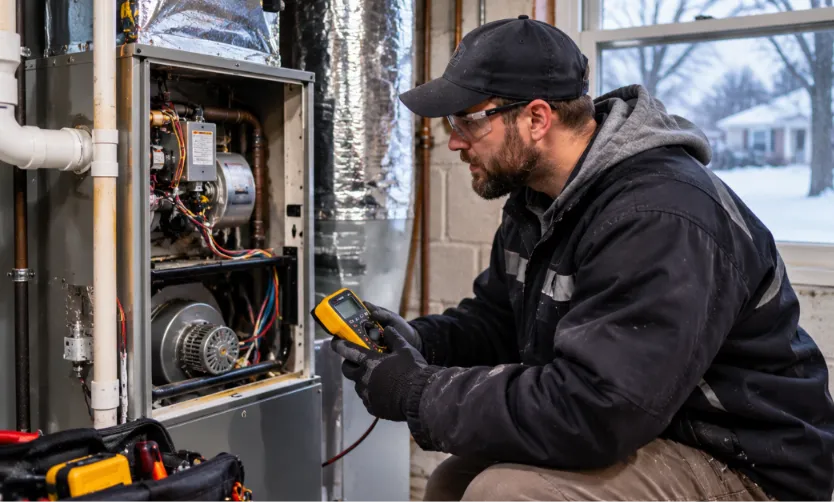
If the house holds temperature and the furnace otherwise operates normally, long runtime alone does not necessarily mean it needs repair. Keep watching the thermostat and the supply vents through the next few cold nights, and note anything that changes.
Call for furnace maintenance service when long running comes with any of these signs. Each one points to a problem that tends to grow through a Mentor winter, and most are cheaper to fix early than in the middle of a cold snap:
- The house falls behind the setpoint: The furnace cannot keep up.
- Short cycling continues after a new filter: A control or sizing problem.
- Persistent burning odor, smoke, or soot: Turn the furnace off and call for service.
- A sudden jump in gas use: The furnace may be working harder than it should.
A fall tune-up can identify many airflow, combustion, control, and safety issues before winter. Regular furnace maintenance can include burner, safety-control, and airflow checks appropriate to the equipment. If your furnace is aging, these warning signs a furnace needs repair or replacement help you decide whether to repair or replace.
Why Choose Buckeye Comfort Solutions for Furnace Service in Mentor?
At Buckeye Comfort Solutions, we understand that a furnace running constantly during an Ohio winter does not always indicate a problem. Our veteran and family-owned company is based in Mentor, and our owner, TJ Follett, brings more than 11 years of HVAC experience along with EPA 608 and OSHA 30 credentials. Our technicians are NATE certified and understand the heating demands of Northeast Ohio homes.
When your furnace struggles to reach the thermostat setting or runs longer than expected, we inspect its airflow, filter, thermostat, temperature rise, and burners to determine whether the runtime is normal or a sign of a developing issue. We provide professional furnace repair in Mentor when a component needs attention and offer furnace maintenance to help identify performance problems before the heating season gets colder.
We believe homeowners should understand what is happening with their heating system before approving work. That's why we provide upfront pricing and offer emergency heating service around the clock, including nights, weekends, and holidays. Financing through Hearth is also available, subject to credit approval. Call Buckeye Comfort Solutions at (440) 664-2827 to schedule furnace service in Mentor.
Frequently Asked Questions
How long should a furnace run per cycle in winter?
It depends on the furnace, the house and the weather. On mild days, cycles may be short. On a frigid Mentor night, a correctly sized single-stage furnace can run for long stretches, and a modulating furnace may run almost continuously. Whether the house holds temperature matters most.
Is it bad for a furnace to run all the time?
Not necessarily. Long cycles can be normal during very cold weather, especially with staged or modulating equipment. Frequent short cycling is generally more concerning than steady operation. Constant running becomes a concern when the house falls behind or other warning signs appear.
Why does my furnace run but the house stays cold?
Common causes include a clogged filter, closed or blocked vents, leaky ductwork, a thermostat problem or burners that are not firing properly. Check the filter and vents first. If the house still falls behind, a technician should measure the furnace's output and airflow.
Should my thermostat fan be set to ON or AUTO?
AUTO suits most homes. With the fan on AUTO, the blower runs with the furnace's normal heating-cycle controls, which makes cycles easier to read and usually limits blower runtime and electricity use compared with leaving the fan continuously ON. ON keeps air moving between heating cycles, which some people prefer for circulation or filtration.
How often should a furnace be serviced in Northeast Ohio?
Annual professional furnace maintenance is commonly recommended, ideally before the heating season. The specific checks depend on the equipment, but a visit can include combustion, safety-control, heat-exchanger, and airflow inspection before the first cold snap.