
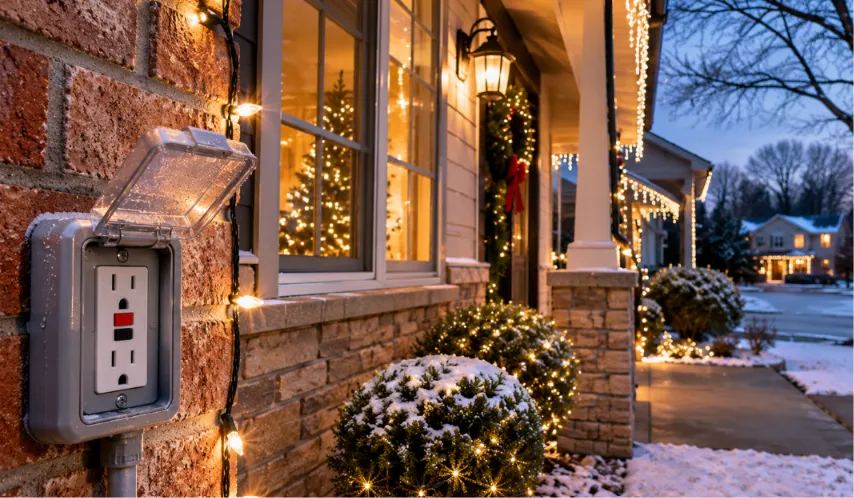
A GFCI outlet is built to cut power when it senses just 4 to 6 milliamps of current leaking away, a tiny fraction of what a single light string draws. That sensitivity is why the outdoor outlet on a Mentor porch keeps going dark once the holiday display goes up.
Moisture is a common cause, especially with outdoor holiday lights. Rain, melting snow and overnight frost can get into plug connections and bulb sockets and create current leakage. Damaged insulation, faulty decorations, downstream equipment, wiring problems, or a failing GFCI can also cause trips. Overloading one circuit usually trips the breaker in the panel, not the GFCI.
How Does a GFCI Outlet Decide When to Trip?
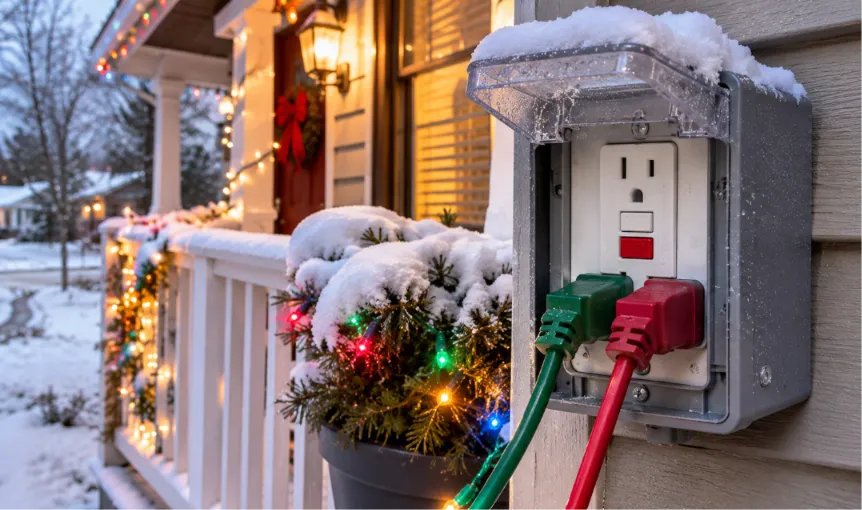
A GFCI compares the current going out on the hot wire with the current coming back on the neutral. In a healthy circuit, the two match. When they do not, some current is escaping, possibly through water, a damaged cord or a person, and the outlet cuts power almost instantly.
UL 943 sets the trip point for home GFCI outlets. A Class A device must trip at 6 milliamps of leakage and must not trip below 4 milliamps. A single incandescent light string draws hundreds of milliamps just to stay lit, so the outlet watches a far smaller number.
That is why a GFCI does not count lights. It trips on leakage, not load. A display with three strings and one wet plug can trip all night, while a large display with dry, sealed connections can run all season without a single interruption.
Why Do Holiday Lights Trip GFCIs More in a Mentor Winter?
Water conducts electricity, and an outdoor display gives it plenty of ways in: plug connections lying in snow, cracked bulb sockets, worn insulation and the outlet itself. When moisture bridges a live wire and the ground, it creates exactly the small leak a GFCI is designed to catch.
Northeast Ohio weather makes this worse than in many places. NOAA's 1991 to 2020 climate normals for nearby Cleveland show an average January low of 22°F and about 26 January nights at or below freezing, with thaws in between. Snow melts into connectors, then refreezes overnight.
Leakage also adds up. Each damp connection may leak only a little, but a long run of strings on one GFCI sums every small leak into one reading. A display that holds fine on a dry evening can trip on a foggy morning once the total crosses the threshold.
How Do You Find the String That Trips the GFCI?
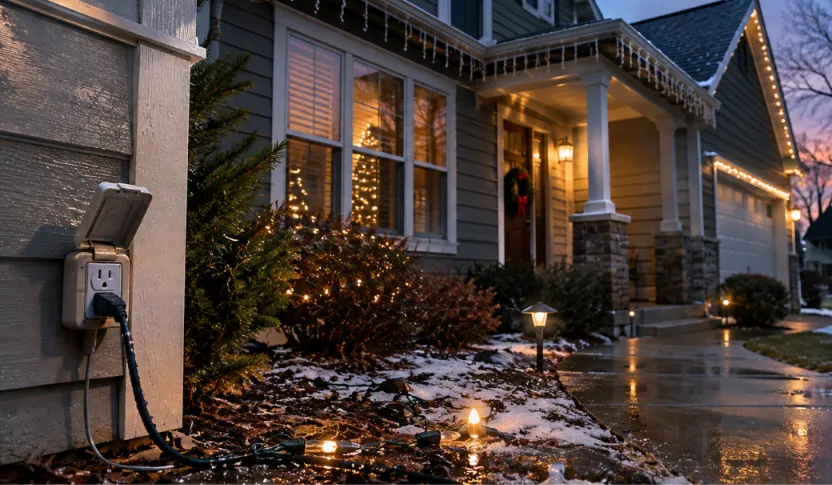
Finding the problem takes patience. Limit homeowner troubleshooting to dry, visible components. Use dry hands, unplug the display before inspecting cords or connections, and do not handle wet or visibly damaged electrical equipment. Work through these steps on a dry afternoon if you can.
Find the Right Reset Button
One GFCI can protect other outlets farther along the same circuit. If the exterior outlet has no buttons, the controlling GFCI may be in the garage, a bathroom or the basement. Check those first, because resetting the wrong outlet, or none at all, wastes time on a working display.
Test the Outlet With Nothing Plugged In
Unplug every string, extension cord and timer connected to the holiday display, then press reset. If the GFCI trips again with the holiday display disconnected, stop troubleshooting. The issue may involve the GFCI itself, moisture in the box, downstream equipment, or the protected wiring.
Add One String at a Time
Plug in one string or one section of the display, wait several minutes, then add the next. When the GFCI trips right after a particular string goes on, you have found the leak. Damp-weather faults can take hours to appear, so be patient with slow trips.
Inspect the Plug Connections
Look closely at the plug ends where strings join. Water collects in these junctions, and green or white corrosion on the prongs is a sign of past moisture. Dry the connection, replace damaged strings and keep every junction off the ground, raised on a stake, hook or brick.
Check the Cords for Damage
With the lights unplugged, visually inspect each cord for cracked insulation, chew marks, crushed sections, exposed conductors, or damaged plugs. A break in the jacket can let moisture reach the wiring and create leakage. Replace damaged strings rather than trying to repair them with tape.
The takeaway is that a damaged string or wet connection is a common cause of holiday-light GFCI trips. Working through the display one section at a time can help isolate the problem. If the GFCI trips again after the holiday display is disconnected, stop troubleshooting and have the protected circuit checked.
Should You Swap the GFCI for a Regular Outlet?
After the fifth reset in a week, many homeowners think about replacing the outdoor GFCI with a standard outlet, or running the display from an indoor outlet through a cracked window. Both feel like quick ways to keep the lights on through the holidays without more trips.
Here is the trap. The National Electrical Code requires GFCI protection on outdoor receptacles at homes because water and electricity together can kill. Removing that protection does not fix the leak. It only means the next wet connection sends current through whatever, or whoever, touches it.
Fix the cause instead. Disconnect wet connections, let them dry, keep connections off wet ground, and use outdoor-rated lights, cords, and connection protection as directed by the manufacturer. Make sure the outlet has a weatherproof in-use cover while cords are connected. If the GFCI itself is failing, have it replaced with a properly rated GFCI.
Is It the Lights, the Outlet or the Circuit?
The timing and the place where power cuts out tell you a lot about the cause. The table below sorts common patterns so you can tell whether to look at the display, the outlet or the circuit before you start replacing lights you may not need to replace:
| What happens | Likely cause | What to do |
|---|---|---|
| GFCI trips on wet or thawing days | Moisture in a connection | Disconnect wet connections, let them dry and use outdoor-rated connection protection |
| GFCI trips when one string is added | Damaged or wet string | Replace that string |
| GFCI trips after the holiday display is disconnected | GFCI, downstream device, moisture or wiring fault | Call an electrician |
| GFCI will not reset at all | Failed GFCI or no power | Call an electrician |
| Breaker in the panel trips | Possible overload, short circuit, or other overcurrent fault | Reduce the load if clearly overloaded; if it trips again, stop and have the circuit checked |
The last row is the one people mix up most. An overload usually trips the breaker in the panel, not the GFCI button. If the breaker trips after adding more lights, the total connected load may be too high. If it trips immediately or repeatedly with a modest load, stop resetting it and have the circuit checked.
How Many Lights Can One Outdoor Circuit Handle?
Most household outlet circuits are 15 or 20 amps. For loads expected to operate continuously for three hours or more, electrical calculations generally allow 80% of a standard circuit's rating. On a 15-amp, 120-volt circuit, that is 1,440 watts for everything on the circuit, not just the holiday lights.
Light strings also carry their own limits, printed on the box or the tag near the plug. Respect both the circuit rating and the string rating. LED strings generally draw much less power than incandescent strings, but the total load from the entire circuit still matters:
- Read the end-to-end limit: The tag lists how many sets can connect in one run.
- Count the watts: An incandescent string can draw several times what an LED string draws.
- Share the load: Split large displays across more than one outlet and circuit.
- Mind other loads: Garage freezers and power tools may share the same circuit.
Many older homes have only one or two exterior outlets, so whole displays end up chained to a single circuit. When the real limit is outlets rather than lights, adding an outdoor outlet on its own circuit is a lasting fix that makes every December easier.
When Is It Time to Call an Electrician?
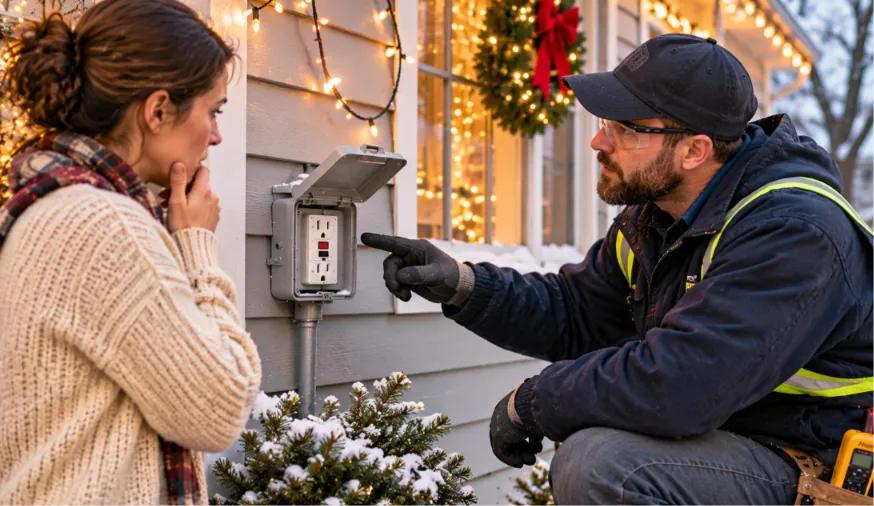
Moisture is a common cause of holiday-light GFCI trips, and some problems can be isolated by disconnecting damaged or wet decorations. Repeated trips can also point to the receptacle, downstream wiring, or another electrical fault. Once the outlet, wiring, or panel is involved, the job belongs to a licensed electrician.
Stop troubleshooting and call when any of these show up. Each one points past the lights to the outlet, the wiring or the circuit behind it, and none of them is safe to keep resetting through the season, even when the display seems to work:
- Trips after the holiday display is disconnected: The issue may involve the GFCI, moisture, downstream equipment, or protected wiring.
- Will not reset: The device may have failed.
- Scorch marks or a burning smell: Turn off the circuit and call right away.
- Water inside the outlet box: The box or cover is letting water in.
The CPSC recommends testing GFCIs monthly with the test and reset buttons. For a lasting setup, a properly installed permanent outdoor lighting system can reduce the temporary plugs and extension-cord connections used each holiday season.
Why Choose Buckeye Comfort Solutions for Outdoor Electrical Work in Mentor?
At Buckeye Comfort Solutions, we are a veteran and family-owned company based in Mentor. Our owner, TJ Follett, served as a Marine Corps avionics technician before building a home-service career, and our team includes master and journeyman electricians licensed to meet Ohio requirements.
When an outdoor outlet keeps tripping, our electricians in Mentor test the GFCI, check the box and cover for water and trace the circuit back to the panel. We install GFCI and weatherproof outdoor outlets, and whole-home surge protection for the rest of the house.
We give upfront pricing before work begins, and emergency electrical service is available around the clock across Lake, Geauga and Cuyahoga counties. Call us at (440) 664-2827 to have your outdoor outlets checked before the next holiday display goes up.
Frequently Asked Questions
Why does my GFCI trip only at night or in the morning?
Those are the coldest, dampest hours. Dew, frost and condensation form on plug connections and inside sockets overnight, creating a small leak that pushes the GFCI past its trip point. As the day warms and dries out, the leak shrinks, so the outlet holds again.
Can too many Christmas lights trip a GFCI?
Not usually through overload alone, because a GFCI responds to leakage, not total load. Overloads typically trip the breaker in the panel. A long display can still trip a GFCI, though, because small leaks from many damp connections add up on one outlet.
Is it safe to keep resetting the GFCI?
A single reset after disconnecting the holiday display can help confirm whether the GFCI will restore power. Repeatedly resetting a GFCI without finding the cause is not a safe fix. Disconnect wet or damaged decorations and call an electrician if the device trips again with the holiday display disconnected.
Do LED lights trip GFCIs less than incandescent lights?
LED strings draw much less power, which helps with circuit overloads, but they can still trip a GFCI if water gets into a plug or socket. Leakage, not wattage, causes most trips, so sealing and raising connections matters for both types of holiday lights.
How long do outdoor GFCI outlets last?
It varies with weather exposure and use. Outdoor GFCIs face rain, snow, heat and freezing temperatures, so they tend to wear faster than indoor outlets. Test them monthly, and replace any that will not reset, trip with nothing plugged in or show visible damage.