 Skip to content



Your outdoor lighting may start the evening looking normal, only for the lights along the far end of your driveway or garden path to appear noticeably dim. In other cases, an entire section of landscape lighting suddenly goes dark while the remaining fixtures continue working. These patterns can point to very different problems, so replacing bulbs without identifying the cause may leave you with the same issue.
When landscape lighting stops working, the location and pattern of the failure provide important clues. A single dark fixture may have a failed bulb or connection, while several lights going out together can indicate a wiring problem or a faulty connection farther upstream. If brightness gradually decreases along a lighting run, voltage drop, cable length, wire size, or transformer capacity may be contributing factors. Understanding these differences can help you narrow down the likely cause and determine whether a simple check is appropriate or professional electrical troubleshooting is needed.
Which Fixtures Failed Tells You Where the Problem Is
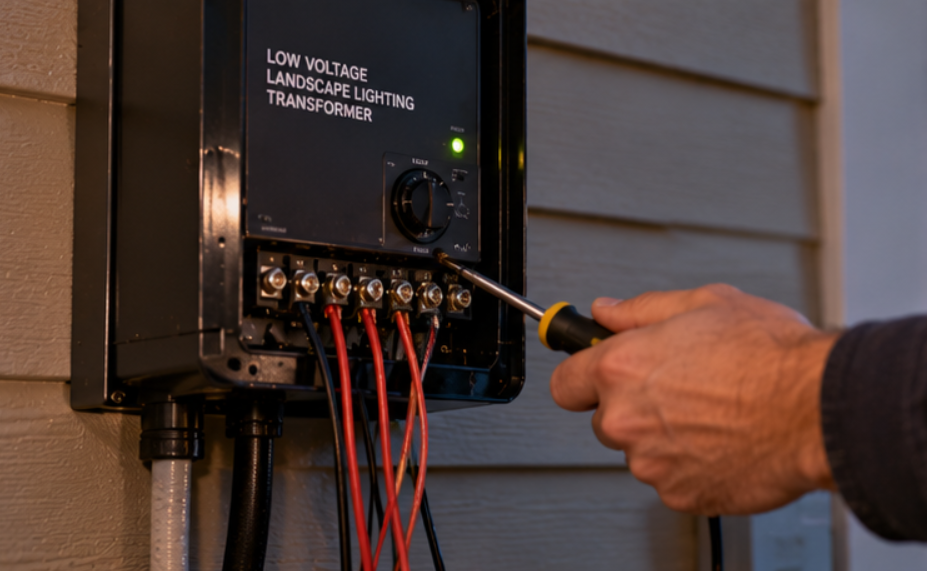
Before you touch anything, walk the run and note which fixtures are dark, which are dim, and whether the dim ones are grouped at the far end or scattered. That map is your diagnosis. A single outage behaves nothing like a whole section dropping out, and both look different from a system where every light has gone weak.
| What you see | Possible cause | Why the pattern looks that way |
|---|---|---|
| One fixture dark, rest fine | Bulb, socket, or that fixture’s lead | A single failure does not interrupt the shared cable |
| A whole section dark | Broken or corroded connection, cut cable | Everything downstream of the break loses power |
| Far fixtures dim, near ones bright | Voltage drop along the run | Voltage falls with distance and cumulative load |
| Every fixture dim | Overloaded transformer, wrong tap | The whole circuit starts below full voltage |
The reason the pattern matters is that many low-voltage lighting systems use runs that branch out from the transformer. On a daisy-chain run, a fault can interrupt everything downstream, so the first failed fixture may help narrow down where to inspect.
Why Did Half My Landscape Lights Go Out at Once?
When a whole section goes dark at once, a loose, corroded, or damaged connection is one possibility. On a daisy-chain run, power reaches fixtures before the fault and may stop at that point, leaving the fixtures farther down the run dark.
Northeast Ohio works against you. Freeze-thaw cycling heaves buried cable and drives moisture into those connectors. A run that glowed all summer often fails in early spring, which is why a section blackout points toward a corroded connection well before a dead transformer.
The other possibility is lost power to the whole system. Many transformers plug into a GFCI-protected supply, and a tripped GFCI or integral breaker kills every fixture at once. If the entire yard is dark, check that first; if only one branch is out, look for a connection fault at its head.
Why Do the Last Lights on the Run Go Dim?
Bright first fixtures that fade toward the end can point to voltage drop. Many landscape lighting systems use 12-volt fixtures, while transformers may provide multiple output taps to compensate for longer runs. As current travels down the wire, voltage can drop enough for the far fixtures to appear dimmer.
Three things commonly influence this: total run length, cable gauge, and the cumulative wattage of the fixtures on the run. Thinner wire and longer distances can increase voltage loss. The acceptable voltage range varies by fixture, so compare readings with the manufacturer’s specifications rather than relying on one universal cutoff.
The useful part is that end-of-run dimming is predictable and fixable. Nothing is broken; the system is simply asking for more voltage at the far end, and several fixes deliver it without tearing up the yard. First, though, rule out the pattern that looks similar but means something different.
Why Are All My Landscape Lights Dim?
If every fixture is weak, near and far alike, the issue may be closer to the power source. An overloaded or improperly configured transformer is one possibility. Some manufacturers recommend leaving extra transformer capacity for voltage loss or future expansion, so follow the transformer’s sizing guidance.
The trap is that load creeps up slowly. Add a couple of fixtures one season, a couple more the next, each pulling its share, until the total quietly passes the rating and the yard dims at once. Nothing broke; the system just ran out of headroom.
Switching older halogen fixtures to LED can reduce total load because LEDs generally use substantially less wattage. That may improve transformer capacity and reduce some voltage-drop issues before a larger transformer or wiring change is considered.
What Can You Safely Check Yourself Before Calling an Electrician?
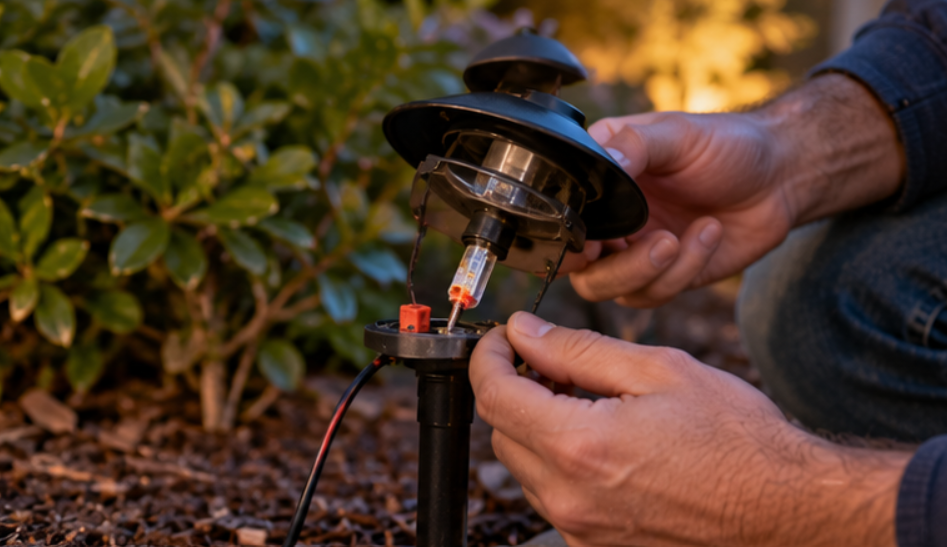
Plenty of landscape lighting faults are no-tool, no-risk checks on the low-voltage side. The smart order is to rule out the easy causes first, before anyone assumes the transformer or buried cable has failed. Work through these in sequence.
Start With the Transformer’s GFCI and Controls
If the whole system is dark, check the outlet feeding the transformer. Press the GFCI reset. Wet spring ground and snowmelt around an outdoor outlet keep GFCI protection tripping here, so a reset is the first move after a total blackout. Then confirm the photocell or timer is working, since a failed control leaves everything off even when the transformer is fine.
Inspect the Accessible Connections
Follow the cable where it runs above ground near each fixture and visually check the accessible connections. Look for green corrosion, loose hardware, or obvious damage. If a connection appears compromised, leave the repair itself to someone familiar with outdoor low-voltage wiring.
Swap a Bulb to Isolate a Dead Fixture
When a single light is out and its neighbors work, the fixture itself is the suspect. Pull the bulb and try a known-good one of the same type and wattage. If it lights, you found it. If it stays dark, the socket, the fixture lead, or the connection to the main cable has failed, and that fixture needs a closer look.
Measure Voltage at the First and Last Fixture
If you are comfortable using a multimeter on low-voltage lighting, comparing voltage near the start and end of a run can help identify voltage drop. Compare the readings with the fixture manufacturer’s acceptable voltage range. If you are unsure where or how to test safely, leave the measurement to an electrician or lighting professional.
Know Where to Stop
Do not open the transformer or dig up and splice buried cable unless you are qualified to do so. Repeated GFCI trips, damaged wiring, transformer issues, and uncertain electrical conditions are good reasons to stop troubleshooting and call a licensed electrician.
If these checks don’t restore your landscape lighting or the far-end fixtures remain dim, the problem may involve transformer performance, cable sizing, or a damaged underground connection. Rather than replacing working fixtures or attempting electrical repairs yourself, consider professional troubleshooting. Explore outdoor and landscape lighting repair services in Mentor to help identify the fault and restore consistent lighting throughout your yard.
Can Voltage Drop Be Fixed Without Rewiring the Whole Yard?
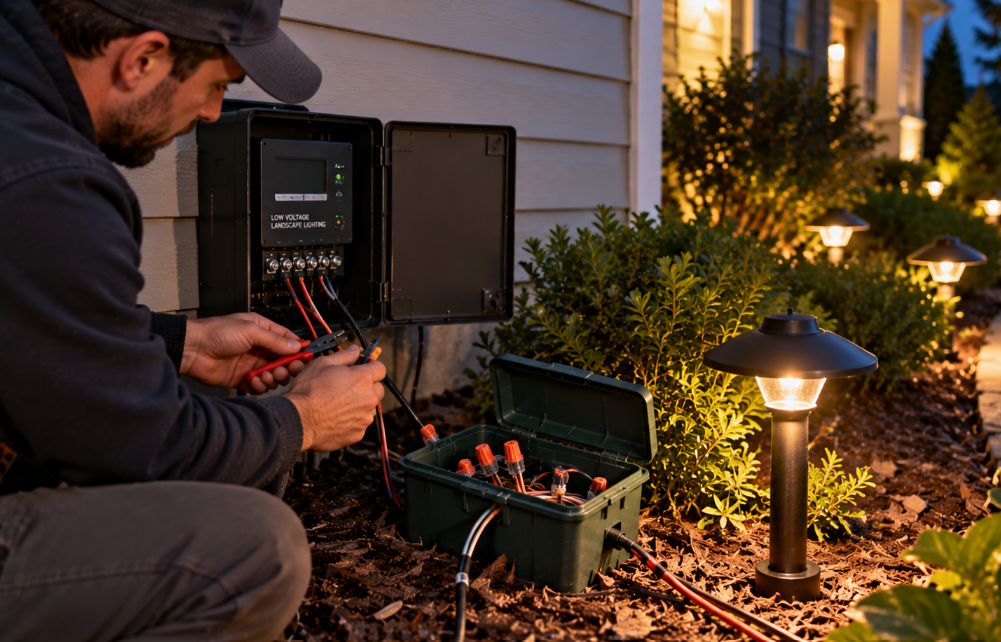
In most cases, yes. Voltage drop and uniform dimming are load-and-distance problems, and there are several ways to solve them short of trenching new cable across the landscape. The right one depends on how your run is laid out and how many fixtures are on it.
Here are the practical fixes, roughly from easiest to most involved:
- Retrofit to LED: Swapping halogens for 4-to-7-watt LEDs slashes total load and recovers voltage along the whole run.
- Adjust the transformer tap: Many transformers offer stepped voltage taps. A qualified installer can select the appropriate tap based on measured voltage and the equipment’s specifications.
- Split the run: Dividing one long cable into two shorter runs off the transformer shortens the distance each one has to carry.
- Re-home far fixtures: Running the last few lights on their own lead back toward the transformer cuts their cumulative drop.
- Upsize only if needed: If the transformer is genuinely undersized after an LED swap, stepping up its rating is the last resort.
The takeaway is that a dim far end rarely means ripping up the yard. An LED retrofit alone solves a surprising share of these. When it does not, the fault has usually moved past the accessible wiring, and that is where a professional earns the call.
When Is Landscape Lighting Repair an Electrician’s Job?
If basic troubleshooting hasn’t restored your landscape lights, the problem may involve a failed transformer, damaged underground wiring, or an electrical supply issue. These faults require proper testing to identify the source without creating additional damage. Knowing when to stop troubleshooting can help you avoid unsafe repairs and unnecessary fixture replacements.
Call a licensed electrician when you notice any of these issues:
- A suspected transformer failure: The lights remain off despite checking the power supply and resetting the GFCI.
- Repeated GFCI trips: Moisture intrusion or damaged wiring may be causing an electrical fault.
- A possible buried cable break: Underground wiring damaged by landscaping tools or ground movement needs proper diagnosis.
- Electrical supply problems: Issues involving line-voltage wiring or the transformer connection require qualified electrical work.
- A new or expanded lighting system: Additional fixtures may require a properly sized transformer, suitable wiring, and appropriate circuit capacity.
How to Choose the Right Licensed Electrician in Mentor
Choose an electrician who has experience diagnosing outdoor lighting systems, including transformers, low-voltage connections, and underground cable faults. Before scheduling service, ask whether the electrician can identify the cause of uneven brightness or failed fixtures, explain the recommended repair, and provide a clear estimate. Hiring a qualified professional helps ensure the repair addresses the underlying issue rather than simply replacing components that may still work.
Why Choose Buckeye Comfort Solutions for Landscape Lighting Repair in Mentor?
When half your landscape lights stop working or the fixtures at the end of a lighting run become noticeably dim, the problem may involve a loose connection, voltage drop, a failing transformer, or damaged wiring. Identifying the underlying cause is essential to restoring consistent illumination without unnecessary replacements or guesswork.
At Buckeye Comfort Solutions, we help homeowners in Mentor, OH, address outdoor lighting problems with professional electrical troubleshooting and repair. Our outdoor and landscape lighting services can help you explore solutions for malfunctioning fixtures, uneven brightness, and other landscape lighting concerns. If the issue requires broader electrical diagnosis, our licensed electrician services in Mentor provide another way to get the problem investigated safely.
Don’t replace every fixture before determining why the lights are failing. Call 440-664-2827 to discuss your landscape lighting issue and arrange professional assistance.
Frequently Asked Questions
How do I test my landscape lighting transformer to see if it’s working?
Start by checking the GFCI outlet, timer, and photocell. Testing transformer output with a multimeter can help narrow down the problem, but the expected reading depends on the transformer tap and system design. If you are not comfortable testing electrical equipment, have an electrician check it.
Can I add more fixtures to my existing landscape lighting?
Sometimes, but only if the transformer and wiring have enough capacity. Check the transformer’s sizing guidance before adding fixtures. Switching older halogen fixtures to LED can reduce the total load and may create additional capacity.
Why do my landscape lights keep tripping the GFCI outlet?
Usually moisture intrusion at the outlet, a connector, or a nicked cable. Wet spring ground and snowmelt are common triggers here. A GFCI that trips repeatedly is doing its job and signals a fault worth tracing, so resetting it over and over is not a fix.
Do LED landscape lights fix voltage drop problems?
They can help because LED fixtures generally use less wattage than comparable halogen lighting, which reduces total load and can improve voltage along the run. They will not fix a broken connection or cut cable.
How long does low-voltage landscape wiring last?
Properly installed direct-burial cable can last for many years, but connections, moisture intrusion, and physical damage may cause problems sooner. In Northeast Ohio, freeze-thaw cycles can also put added stress on outdoor lighting connections.


