 Skip to content


Plenty of Mentor’s charm lives in its older homes: the postwar ranches off Mentor Avenue, the capes and colonials with radiators and original plaster walls. They are solid, well-built houses, but they share one frustrating trait every summer. They were never designed with central air in mind, and cooling them evenly can feel like a losing battle by mid-July.
If you have been stuffing window units into bedrooms or sweating through a hot upstairs, a ductless mini-split is worth a serious look. Here is how these systems work, why they suit older houses so well, and what to weigh before booking a ductless mini-split installation in Mentor.
Why Are Older Mentor Homes So Hard to Cool?
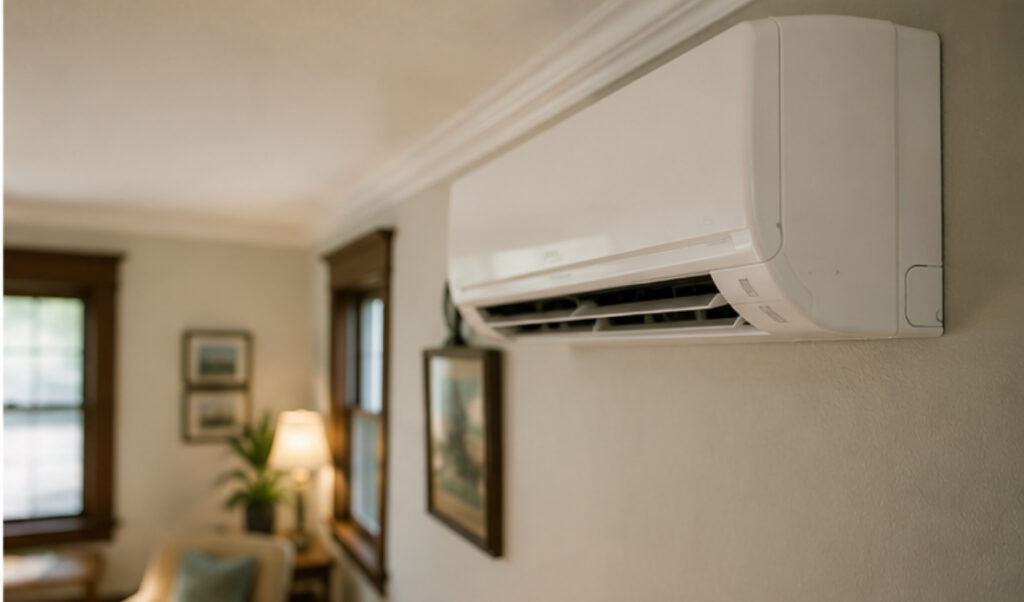
The trouble usually starts with the bones of the house. Many older Mentor homes were built with boilers and radiators or with very limited ductwork, which means there is no easy path to push cool air where you actually need it. Add in the layout and materials of a mid-century build, and a handful of specific problems show up summer after summer:
- Homes built before the 1970s often have no ductwork at all, ruling out a simple central AC add-on.
- Radiator and boiler heating leaves no air handler or ducts for a cooling system to share.
- Upstairs bedrooms trap heat, since warm air rises and older insulation does little to slow it.
- Window units cool one room loudly, block the view, and leave hallways and corners stuffy.
- Additions and finished attics rarely connect to whatever limited ductwork the house does have.
Tearing open plaster walls to run new ducts is expensive and messy, which is exactly the problem ductless systems were built to solve.
How Does a Ductless Mini-Split Work?
A ductless mini-split splits the job between two parts. An outdoor compressor sits beside the house, much like a central AC condenser, and connects to one or more slim indoor units mounted high on a wall or ceiling. Instead of ducts, a small bundle of refrigerant lines and wiring links them, delivering conditioned air straight into the room.
Each indoor head cools, and heats, the space it serves directly, with no ducts to lose energy along the way. Because it is a heat pump, the same system reverses in winter to warm the room, so one quiet unit handles comfort in both seasons rather than just the summer.
The indoor heads are compact and unobtrusive, a slim panel rather than the bulky box of a window unit, and they tuck high on a wall where they stay out of the way. Most run off a handheld remote or a wall control, which makes that simple two-part design the reason a mini-split slips into an older home where central air cannot.
Why Do Mini-Splits Fit Older Homes So Well?
The biggest advantage is what the install does not require. Connecting the indoor and outdoor units takes only a small opening, usually around 3 inches across, drilled through an exterior wall for the refrigerant lines. There are no ducts to route through ceilings, no soffits to frame out, and no plaster to tear open and repaint when the job is done.
That keeps the work clean, fast, and far less disruptive than retrofitting ductwork into a finished home. The indoor heads can go where they make sense, a stuffy upstairs bedroom, a sunroom addition, or a finished attic, so you treat the exact rooms that have always been hard to keep comfortable.
For an older Mentor house, that flexibility is the whole point, and it is why a professionally installed mini-split often beats forcing ducts into spaces where they were never meant to go.
What Are the Benefits for an Older Mentor Home?

For many older Mentor homes, the biggest challenge is not generating cool air; it is getting that cool air to the rooms that need it most. Homes built with boiler heat, radiators, or limited ductwork often struggle with hot second floors, uncomfortable additions, and rooms that never seem to match the thermostat setting. A ductless mini-split addresses those problem areas directly without requiring a major renovation.
Target the Rooms That Struggle Most
One reason mini-splits work so well in older homes is their ability to cool specific spaces independently. Rather than forcing an entire house onto one system, you can focus on the areas that consistently become uncomfortable during Northeast Ohio summers.
Avoid Expensive Ductwork Retrofits
Installing central air in a home that was never designed for ductwork often means opening walls, modifying ceilings, and finding pathways through finished spaces. In older homes with plaster walls, hardwood floors, and original architectural details, that process can become both expensive and disruptive.
A ductless mini-split typically requires only a small opening for refrigerant lines, allowing cooling to be added with far less impact on the home’s structure and finishes.
Improve Efficiency Without Cooling Unused Rooms
Many homeowners rely on multiple window units to manage summer heat, but those systems often cool inefficiently and consume more electricity than expected. Because mini-splits use inverter-driven technology and deliver conditioned air directly into the room, they avoid the energy losses associated with ductwork and allow homeowners to cool only the spaces being used.
Create Better Room-to-Room Comfort
Temperature differences are common in older Mentor homes, especially between floors. A mini-split gives each zone independent control, allowing a warm upstairs bedroom, finished attic, or home office to maintain its own comfort level without affecting the rest of the house.
For homeowners tired of noisy window units, hot upstairs rooms, or the cost and disruption of adding ductwork, a ductless mini-split often provides one of the most practical cooling solutions available. The ability to add targeted comfort where it is needed most is exactly why these systems have become such a popular upgrade for older homes throughout Lake County.
Can a Mini-Split Heat Through a Northeast Ohio Winter?
Many Mentor homeowners assume mini-splits are only useful during summer, but modern cold-climate systems are designed to provide heat as well as cooling. Today’s inverter-driven heat pumps can continue producing usable heat even when outdoor temperatures drop well below freezing.
That matters in Lake County, where winter temperatures regularly fall into the teens and occasional cold snaps bring single-digit conditions. A properly sized cold-climate mini-split can comfortably heat bedrooms, additions, finished basements, sunrooms, and other spaces throughout much of the heating season.
When Does Backup Heat Still Matter?
For most older Mentor homes, the mini-split works best alongside an existing furnace or boiler. During extreme cold events, the existing heating system can handle the heaviest demand while the mini-split continues delivering efficient supplemental heat.
This hybrid approach allows homeowners to improve comfort year-round without completely replacing a heating system that still has useful life remaining.
When Might a Mini-Split Not Be the Best Choice?

Although mini-splits work exceptionally well in many older Mentor homes, they are not the right fit for every situation.
Homes that already have well-designed ductwork and a relatively modern furnace may find that adding central air is more cost-effective when cooling the entire house. Likewise, homeowners who dislike the appearance of wall-mounted indoor units may prefer a ducted solution.
A mini-split also depends heavily on proper sizing. An undersized unit may struggle during humid Northeast Ohio heat, while an oversized unit can short-cycle and reduce efficiency. That is why a room-by-room load calculation matters before installation.
For most older homes without existing ducts, however, mini-splits remain one of the most practical and least disruptive cooling options available.
Single-Zone or Multi-Zone: Which Fits Your Home?
Mini-splits come in two basic setups, and the right one depends on how much of the house you want to cover. A single-zone system pairs one outdoor unit with one indoor head, while a multi-zone system runs several indoor heads off a single outdoor unit. Choosing between them comes down mostly to scope and budget.
| Factor | Single-Zone | Multi-Zone |
|---|---|---|
| Rooms served | One | Several |
| Best for | A hot bedroom or addition | Whole-home comfort |
| Upfront cost | Lower | Higher |
| Indoor units | One head | Multiple heads |
| Control | Targeted fix | Independent per room |
Sizing is not a guess, either. An oversized system short-cycles and wastes energy, while an undersized one never keeps up, so a load calculation for each room is what gets it right. Many Mentor homeowners start with a single zone for the worst room, then expand later as the budget allows.
Why Choose Buckeye Comfort Solutions for Ductless Mini-Splits in Mentor, OH
Older Mentor homes present cooling challenges that newer homes simply do not have. Boiler heat, limited ductwork, finished attics, hot second floors, and room additions all require a different approach than a standard central air installation.
For more than 11 years, Buckeye Comfort Solutions has helped Lake County homeowners improve comfort with properly sized ductless systems designed around the home’s layout, insulation levels, and cooling demands. Our licensed HVAC team performs detailed load calculations to determine whether a single-zone or multi-zone solution makes the most sense for your space.
Whether you are exploring a new ductless mini-split installation for an upstairs bedroom or comparing options alongside a traditional air conditioning installation, we provide honest recommendations based on your home’s needs, not a one-size-fits-all solution.


